An Alternative Scenic Route
How a travel concept store in Seoul revealed a new lens and, with it, a wild new way to travel
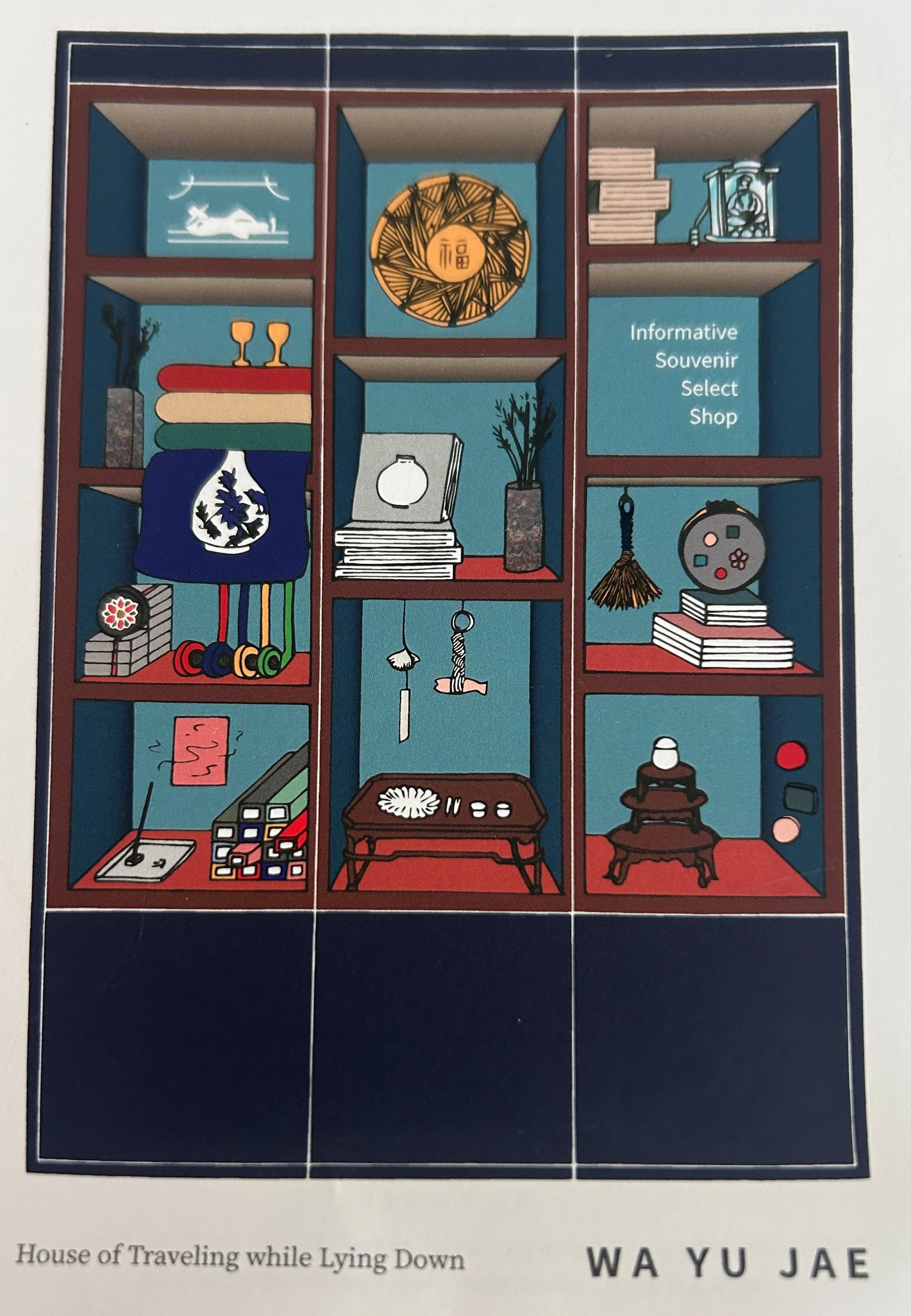
During the perfect autumn stroll on the perfect autumn afternoon in Seoul, South Korea, I happened across an especially unique travel concept store called WA YU JAE.
Like so many of the stores in its neighborhood, this modern boutique projected a sophisticated and cool sensibility. It was handsomely pristine and full of charm and character, carefully curated with just the right assortment of high-design trinkets, tchotchkes and objets d’art to stop a browser in her tracks. Each article, in its own way, seemed to add one more beat, extra layer of texture or dimension to Korea’s vividly rich and endlessly creative culture.
The shop felt alive. And I felt more alive in it.
WA YU JAE’s staff were energetic and friendly, warmly engaging each customer at the front door with a just-brewed cup of barley tea. I took my time looking around, as interested in buying as I was in learning about where each item had come from and what it meant.
At some point in my self-guided tour around the boutique, I found a tidy stack of branded postcards. I picked up the English version and read on as it explained the origin of both the WA YU JAE name and the retail concept that sprang forth from it.
WA YU JAE was more than just a kitschy gift shop for the discerning, curious traveler. It was a collection of novel but treasured and practical travel goods inspired by the Chinese aesthetic idea, wòyóu (卧游), which translates to “traveling while lying down.”
In a grateful kind of knowing, I stared down at the postcard in my hands. I reread what “traveling while lying down” meant. I blinked hard a few times, buying myself a few more seconds for it to sink in. What a completely foreign but fascinating philosophy I had just stumbled into.
I looked around, taking in the space again with fresh eyes.
I took another trip around the store, slowing to regard items I had passed over the first time through, considering them now with the shop’s intention top of mind. As the postcard had gone on to describe, the term WA YU (wòyóu) originated many centuries ago, when scholars had hung paintings in their homes of places that they either wanted to visit or had visited before.
These paintings were gateways: access to memories, or in the case of destinations not yet physically traveled to, symbols of a very personalized set of yet-to-be-lived or -fulfilled travel aspirations.
I loved how expansive and inclusive the premise felt. How whimsical and inviting it all seemed. Being in this store suddenly had renewed purpose and meaning for me.
Later that evening, I couldn’t stop thinking about how I had found such an elegantly simple principle. I had read the postcard over and over again, tucking it into my notebook for safekeeping before I went to sleep that night. As I drifted off, I may not have understood at the time what wòyóu meant or could mean to me, but I knew it had a role to play in my coalescing belief that travel was a journey, not a series of disconnected episodes.
And so now, sensing that I’m at a personal crossroads, I am ready to finally click wòyóu into place to work out what it really means. As a lens, I suspect it will help me concentrate on measuring movement where it is most meant to impact us: our hearts and minds.
***
After spending more time with wòyóu for Tessera Ed. 80, I realized it was much more familiar than it had first appeared. While I hadn’t ever seen it formalized as a method of travel before, I had almost instantly recognized the feelings and ambitions it sought to set free.
My mind went to one of the more visceral consequences of travel that even the most casual of travelers know intimately well. Every time we embark on a journey we’re excited about, we are guaranteed to experience, almost magically, three distinctly different phases of joy at three completely different stretches of time.
If I look back to my last journey and conjure up the wheels-up anticipation that preceded it, I don’t have to try too hard to collect all the bursts, fits, spells, spasms and pops of joy that getting excited for Vilnius had set in motion. They seemed to explode all around me one after the other like the crowd-pleasing, over-the-top finale of a fireworks show. Researching restaurants, bars and sites of interest; talking about where I was going and why with anyone who would listen; and merely picturing what it would be like to move there all over again had stoked a certain cheerful reality for my trip before I ever packed a bag.
And my other journeys this year?
Before landing in Mexico City this past spring, I had compiled a gluttonously long list of more than a dozen taquerias I wanted to sample during my six days in the city. All I had to do in the weeks leading up to the trip was picture one of those tacos and my mouth watered in pining, blissful expectation.
In charting my course around the Western Cape of South Africa, booking tours for whale watching, Robben Island and the Cape of Good Hope, and mapping out reservations for wine tasting across three different wine regions, I had aroused a bright and deepening curiosity for what movement on the Cape could feel like.
And earlier this year, ahead of my trip to New Zealand, when I focused on getting the best itinerary for me locked so that Taste, not pressure to conform, guided my every movement, I felt it then too.
More joy.
Of course, we also experience joy when we take the trip itself. But if we deprive ourselves of the joy of simply sitting in anticipation before a trip, then we overlook and essentially waste that journey’s true and absolute potential.
Similarly, if we over-compartmentalize and draw stiff boundaries between the who we are in motion and the who we are after we return home from travel, we risk cutting a journey’s lifespan and legacy short. And when we do, we don’t just curtail its ability to summon joy; we shortchange our ability to digest and metabolize the real meaning and growth that this exclusive breed of joy can inspire through our travels.
Re-encounter joy, then – the joy that amazingly returns upon recall post-journey no matter how many times we summon it – completes travel’s best-understood triple crown. The ingredients assemble effortlessly behind the scenes. After every trip, memories spread out and embed, following us home like a suntan, those extra few pounds or a post-workout glow. These memories float to the surface, triggered sometimes by our own reminiscing or sometimes by an external prompt: a book, walk, flavor, song, smell. As they do, they sprinkle and spackle us with a whole new patina of joy: remixed and recontextualized.
To think that these memories can gush forth on the back of whatever our consciousness dreams up and desires is extraordinary, not to mention infinitely iterative. That longing to keep a journey alive is why we buy souvenirs, take hundreds of photos, mail a postcard, get a tattoo, swipe the hotel slippers.
As it turns out, revisiting and reliving a trip that mattered is the closest our conscious mind can come to replicating, without physical props like paintings, photographs or relics, the conditions for that wòyóu post-journey reflection. Remembering a trip taken, however, is only one facet of the larger lying down travel system. And it is only one facet if we render and marry those re-encounter memories in horizontal stillness.
The other side of wòyóu’s premise feels revolutionary and unconditional. It challenges us to go, champions us to go, wherever our inner voices compel us. My list is comically and prohibitively long, impractical, complicated and downright harrowingly expensive.
What’s wild is that among all that dreaming, speculating and scheming, I have never once thought about just closing my eyes, clearing my mind, and going.
For forty-seven years I’ve invented and followed darker, more disserving narratives instead. I’ve permitted my mind to misuse the creative resources around it so I could play out every potential wrong turn, missed opportunity and bad decision. By doing so, I have already scribed a university library full of catastrophic volumes in the timid soul’s tongue – heartbreak, humiliation and disaster.
At the same time, I’ve drained one creative cup after another, playing out in excruciating detail every worst-case scenario, that-will-never-work and woulda-coulda-shoulda. And in moments of genuine fear and doubt, I’ve tolerated burning precious time and energy, and worse, dedicating heart and soul to teleporting myself into chemo chairs, serial killers’ basements, tornado vortices, bankruptcy courts and lost baggage claims.
I can be a most wicked and self-sabotaging genius of a storyteller.
But as eager and willing as I am to always write out ahead, I have never voyaged to Machu Picchu, Jaipur, Tanzania, Petra’s Treasury or the Galápagos Islands. I’ve never seen the icebergs of Antarctica, the summit of Mount Everest or the pink sand beaches of Komodo Island.
Why do we let our minds wander down passages of doom and failure when there are so many more breathtaking, life-changing roads to take, accessible without tax or toll, with merely a shutter of our eyelids?
I’m not advocating for letting our passports expire, reallocating the travel budget to orange wine and caviar or zipping ourselves up into a sleeping bag to visit the Great Barrier Reef. Rather, I am imploring us to consider the alternative scenic route – the one that cuts straight through the heart of our imagination.