
Lenses Change Everything
On collecting the invisible gifts that transform how we move through the world
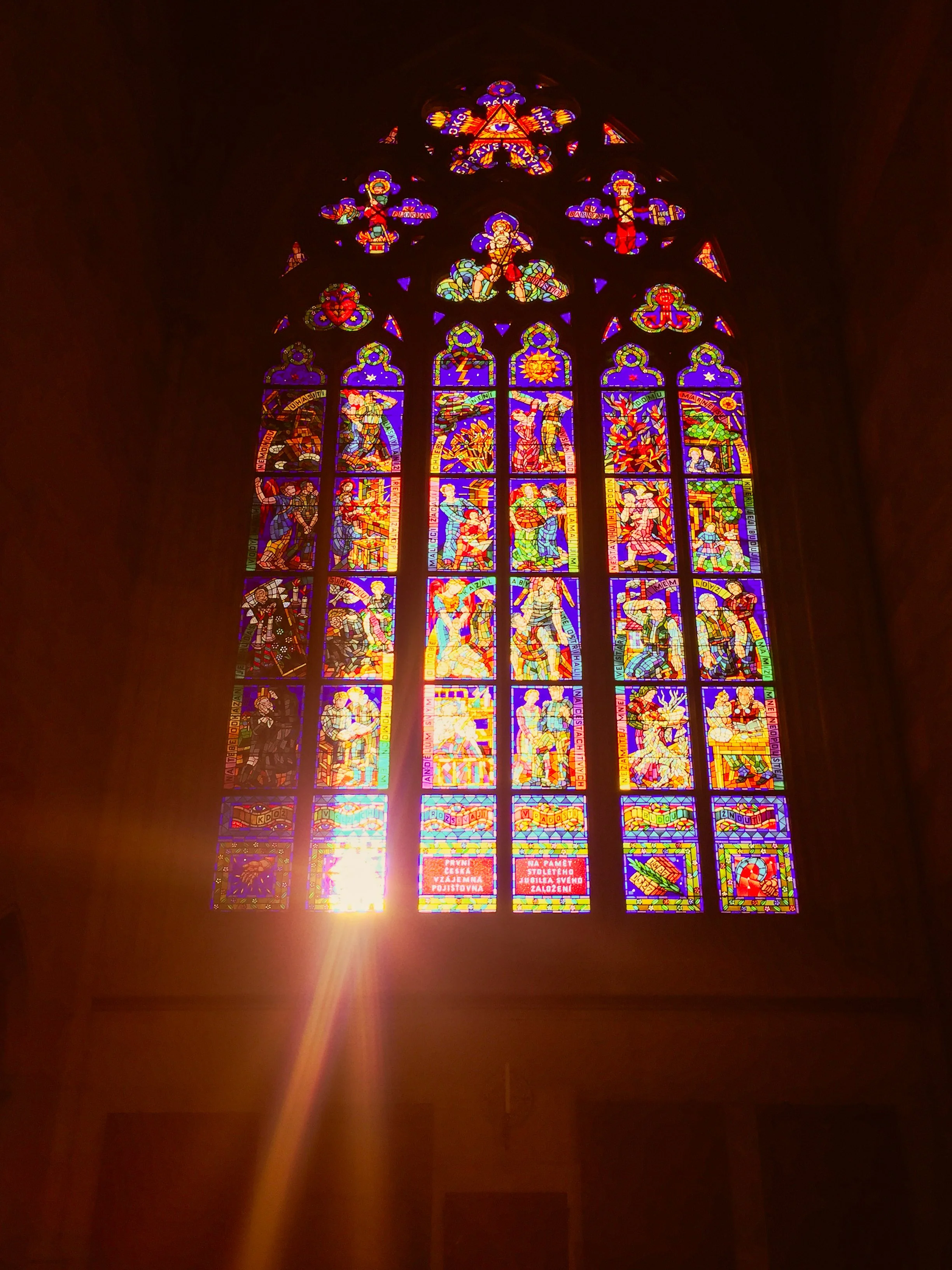
Sunbeam through a stained glass window at St. Vitus Cathedral in Prague, Czechia
From the same undefined but safeguarded somewhere that preserves the places that hold a piece of us and the places that stir and wake us, live the places that provoke and transform us.
I like to think of these places as the ones that have held a fateful gift for us, not in a mystical sense but one conceived instead out of our own architecting and willing into life. When the time is right to collect, all we have to do is answer their call.
As I think about those places and the thoughtfully curated assortment of gifts they’ve bestowed upon me over the years, my memory first and unflinchingly calls back to what I took away from a 24-hour stopover in Tokyo last November. It was there that I first became aware of the Japanese concept of Mottainai.
At the time, I wouldn’t recognize Mottainai for what it was – a way of reframing all of life’s moments, movements and missteps to see the blessing, value and productivity that lives within. Mottainai is a way of flipping the idea of waste on its head. For there is no waste – nothing that can’t and shouldn’t be fully used or applied. Everything, therefore, has meaning and purpose.
Only after trying to make sense of the discouraging gap I experienced in Tokyo between my good and not-so-good choices had I come to name and identify Mottainai. Even though this was my third trip to the city, Tokyo had crushed and humiliated my Type-A perfectionism yet again. It wasn’t the first time, and I suspect it won’t be the last, that I struggled between feast and famine moving about this intimidating, tastemaking giant.
But a nudge and a hunch inspired me to gaze through the veil of Mottainai when examining my comings and goings there. While I had left Tokyo feeling sorry for myself, agitated by an endless, catching string of what-ifs, Tokyo had surreptitiously given me a whole new way of embracing travel with intent.
Tokyo’s parting gift to me wasn’t a gut punch. Rather, it was a fresh perspective. By being so hard to establish any rhythm in, Tokyo had readied me for the lens I was always meant to look through. As only it could, Tokyo helped me understand just how much every second matters – especially the wrong turns, the bad choices and the miscalculations.
There is no waste in travel.
As invaluable as that gift was then and remains so to this day, those 24 prickly hours in Tokyo had activated something even more powerful and lasting still.
A wave of recognition.
During that window of time, a flash in the span of a life, I discovered a deeper way to engage with travel.
That wave of recognition opened my eyes to see connectivity not just between decisions on the road, but among the chapters of my life. It provided a metaphor from which to process meaning in movement when words seemed to fall short, when creative resolution seemed to be percolating just out of reach, when eureka seemed but one more dig of the pickaxe away.
But most of all, it inspired an acceptance that the places that transform us do more than just educate, enlighten and shape. They give us an unspoken language from which to interpret and translate, codify and pattern, metabolize and taste the beauty, wonder and awe of the world we wish to move about in.
I call these souvenirs from the places we pass through that hold a mysterious and inimitable ability to change how we move forever — lenses. Among other things, they can look and feel like cheat codes, universal passkeys, mirrors, superpowers and lifelines.
Lenses play a critical role in the philosophy of intentional travel I’ve been developing and leaning into this past year. Until I found a way to formalize my own travel experiences through them, I felt like I was trying to read a book without a spine.
Lenses are the difference between carrying meaning forward with permanence and lifelong accessibility and letting it land only momentarily and superficially, where it will evaporate without a trace.
Put another way, lenses are metaphors we come to see the world through – not always evident to us at first – but always waiting to reveal themselves when we travel with intent and a clear why clicked into place.
They are acutely personal discoveries, deeply contextual to who we are, the load and dreams we carry and the potential and purpose we wish to unlock. Lenses become a vital way travel integrates into our lives as a continuous journey, blurring the lines of the soul we are en route and the soul we are in situ.
The more we travel, the more we collect lenses. The more we collect, the more we import fresh perspective back home. They give us a chance to coalesce scattered points of view, accentuate common ground over manufactured differences and spread wisdom and tolerance across cultures and customs.
Over the last year, I’ve felt lenses at work in my own travels across destinations and seasons. They have transformed everyday collisions and exchanges into meaning makers, breadcrumbs and long, slow dramatic pauses. They have reinvigorated me just as they have reinforced the path I’m moving down. They have influenced the way I think, the way I create and most of all the way I move.
I have come to believe that for a place to feel like it has really moved us, we need to have brought something intangible and irreplaceable home – a fateful gift.
Lenses check that box. They set us up from a different vantage point, often equipping us with an appreciation for a concept turned upside down or inside out and permission to see what’s been hiding in plain sight in front of us all along. But they are not magical. They are meaning of our own enabling and making. We just have to be alert and ready to receive what’s meant to come home with us.
If Mottainai opened the door for lenses to permeate my travel practice, then this next lens held it open for all the others to flood gloriously in.
I was only able to put a name to this prolific lens a few weeks ago when I came across Jacques Bonnet’s concept Bibliothèque Intérieure. Bibliothèque Intérieure is a French term Bonnet uses to represent the invisible collection of books we read and thus “carry” with us over the course of our lives. When I heard it, two things struck and stayed with me.
One, I finally had words to put to the mysterious, almost preordained reading list that’s auspiciously accompanied me across my untethered becoming journey and the travel that animates it.
Two, while the Bibliothèque Intérieure lens is a beautiful metaphor for what we come to read, it is also a complementary concept to my belief that travel is a journey. Both are plentiful, inexhaustible wells where we come to store every drop of the awakening richness reading and traveling provide. We inevitably draw upon both of them whenever we need a catalyst, a muse or an oasis.
My inner library has become blissfully overrun by titles inseparably linked to the places I’ve been, the lessons and curiosities they’ve provoked and the cultural literacy they’ve all but demanded of me. How lucky I am to have married two loves and taken them both on the same journey!
Sometimes the book pairings are obvious, as if curated by a masterful sommelier: Stanley Tucci’s Taste read traveling through Tuscany; Ina Garten’s memoir, Be Ready When the Luck Happensread moving through the gastronomic paradise that is Spain; James Kerr’s Legacy about the New Zealand All Blacks read crossing the South Pacific.
My favorite couplings, however, are those spun off by more unlikely duets – Jane Goodall’s memoir, Reason for Hope: A Spiritual Journey read in Seoul and Kyoto; Suneel Gupta’sEveryday Dharma readin Bled, Slovenia; and Maya Angelou’sI Know Why the Caged Bird Sings read touring New Zealand. There is something about absorbing a brilliant book against a brilliant, unexpected backdrop. Going back to Bibliothèque Intérieure, this dynamic feels like the perfect way to further dimensionalize and enrich our inner libraries.
More often than not, reading begets more lenses. The book that set my journey in motion, before I even knew it was taking form inside of me, was Ikigai: The Japanese Secret to a Long and Happy Life by Héctor García and Francesc Miralles.
Ikigai is another Japanese concept. It is our reason for being that brings true and lasting meaning and joy to our lives. Our ikigai lives at the intersection of what we love and what we’re good at and what the world needs and what it will pay us for. The book tackles calling and purpose with a soulful, practical underpinning. In my case, reading it planted a seed.
It is entirely possible that while I was absorbing every word of this text, it was already outfitting me with my very first lens. Weeks after reading it, I would come to travel through Spain on the trip that transformed me from a disillusioned, uncommitted yet yearning creative into a taste-led writer hungry for self-discovery and connection.
But not just hungry to taste the world, hungry to feel more of it.
Hungry to – fully, freely and finally – see it.
Every week, I send one new Tessera Blog on taste, travel and the truths we collect along the way. If this piece resonated, I’d be honored if you’d share or subscribe.
